


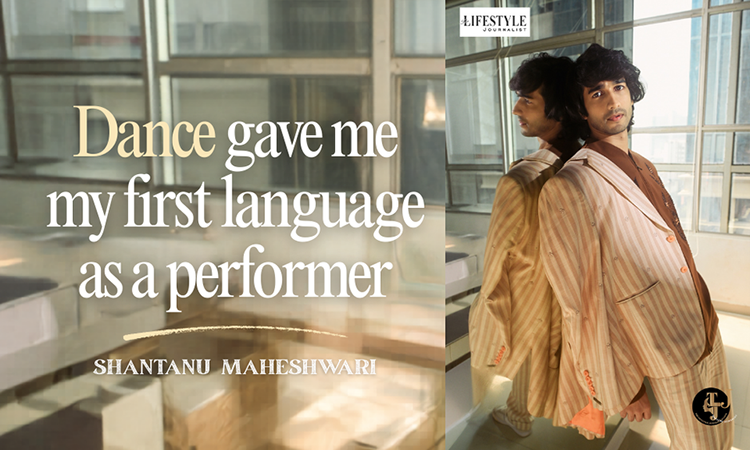
From the rhythm of dance floors to the intensity of cinematic storytelling, Shantanu Maheshwari has carved a journey defined by discipline, passion, and artistic evolution. First winning hearts with the cult youth show Dil Dosti Dance, he quickly emerged as one of India’s most admired dancer-performers. Over the years, he expanded his canvas with powerful film performances in Gangubai Kathiawadi and Auron Mein Kahan Dum Tha, proving his versatility as both a dancer and an actor. In this candid conversation, Shantanu reflects on his artistic beginnings, evolving definitions of success, and the quiet philosophies that guide his journey today.In Conversation with Ankur Vadhera, Managing Editor TLJ Magazine
You began your career as a dancer and became a household name with Dil Dosti Dance. How did your early experiences in dance shape your identity as an artist?
Dance gave me my first language as a performer. Before I even understood acting, storytelling, or camera presence, I understood rhythm, discipline, and expression through movement.Shows like Dil Dosti Dance were not just opportunities — they were classrooms. I learned how to perform under pressure, how to connect with an audience, and most importantly, how to stay hungry.Dance also taught me humility. No matter how good you think you are, there is always someone better who inspires you to keep learning.Even today, whether I’m acting in a film or performing on stage, that dancer in me still guides the way I approach every character.


You’ve grown from a youth icon to a pan-India performer. At this stage of your life, what does success truly mean to you — applause, impact, or inner peace?
Earlier, success was very simple — it was applause. If the audience loved your performance, that was everything.But with time, your understanding changes. Today, success for me is a balance of impact and inner peace. I want my work to move people and inspire them in some way, but at the same time I want to feel fulfilled with the choices I’m making as an artist and as a person.Applause fades quickly. The impact of meaningful work — and the peace you feel while doing it — stays much longer.

After films like Gangubai Kathiawadi and Auron Mein Kahan Dum Tha, how do you handle the pressure to constantly prove yourself to audiences and directors?
Pressure is part of the profession, and honestly, it’s not always a bad thing. A little pressure keeps you sharp.For me, the focus is always on the craft. If I start thinking too much about expectations or comparisons, it can become overwhelming.Instead, I try to approach each project like a student again — learning something new, challenging myself, and giving the role complete honesty.
When you focus on the work, the noise slowly fades away.
Many people know Shantanu the performer — but what’s one personal belief or hobby that your fans might be surprised to learn about?
I actually enjoy quiet spaces a lot. People often assume performers are always loud or extremely social, but I’m quite the opposite.I like spending time reading, playing, reflecting, and sometimes just observing life around me. Those quiet moments are where I recharge creatively.Another thing people may not know is that I genuinely enjoy building things — whether it’s ideas, concepts, or even spaces like my studio. Creating something from scratch excites me.
You’ve often chosen roles that are emotionally layered rather than loud. Is that a conscious choice reflecting your personality?
I think it’s a mix of instinct and personality. I’ve always been drawn to characters that have emotional depth rather than just external drama.Sometimes the most powerful performances come from the smallest moments — a pause, a look, a silence. Those layers interest me as an actor.It’s not a conscious effort to do only certain types of roles. I’ve explored different characters, and as a performer that’s the idea.
I feel layered characters are more human, and I love playing them because they challenge you as an actor.
If you could collaborate with any international dancer or filmmaker, who would it be — and what kind of project would excite you the most?
From a dance perspective, working with someone like Galen Hooks or Bboy Cloud would be incredible because their choreography blends storytelling and movement so beautifully. From a filmmaking perspective, someone like Martin Scorsese or Baz Luhrmann would be fascinating. I love how differently they tell their stories.A project that combines strong storytelling with movement and emotion would excite me the most — something where dance becomes a narrative language.

Has there ever been a role you turned down that still lingers in your mind?
Every actor has moments where they wonder what if. But I try not to look back with regret.Sometimes a project may not align with where you are in your journey at that moment. Later it may become successful, but that doesn’t necessarily mean it was the right choice for you at that time.So I try to trust my instincts and move forward. Having said that, till now — no regrets.
Q. Looking ahead five years, do you see yourself exploring direction, choreography, or producing — or is acting still your strongest calling?
Acting and dancing are definitely still my strongest calling. It’s the space where I feel most alive creatively.But I’m also curious by nature. Over time, I would love to explore choreography more deeply again, maybe even direction someday.Right now I’m also exploring entrepreneurship through my studio space — building something creative beyond just my own performances.
I don’t like to restrict myself and prefer to go with the flow… so never say never to your instincts.
If you had to give one honest piece of advice to young performers who idolise you, what would you tell them about the realities of this industry?
The biggest advice would be — fall in love with the process, not the fame.This industry looks glamorous from the outside, but behind every success there are years of struggle, rejection, and uncertainty. If you’re only chasing fame, the journey becomes very difficult.
But if you genuinely love performing, creating, and improving yourself every day, then the journey itself becomes rewarding.
What does love mean to you at this stage of life?
Love always has to be selfless — period. If I need to elaborate further, it’s about understanding and respect.Earlier, love may feel very intense and dramatic. But with time you realise it’s more about trust, comfort, and allowing the other person to grow as an individual.It’s about two people supporting each other’s journeys without losing their own identities.

“Fall in love with the process, not the fame. If you truly love performing and improving every day, the journey itself becomes the real reward.”